
Salar de Uyuni Travel Guide: Best Time to Visit, Tours & Tips
There is a moment on every Uyuni tour when the car stops, the doors open, and everyone goes quiet. In every direction there is nothing but white salt and sky. After more than 14 years of guiding travelers across Bolivia, we still see that reaction every week — and it never gets old.
This guide is written by our team in La Paz, the same people who run tours on the salt flats every day. It covers what the Salar de Uyuni actually is, when to go, how to get there, what you will see, and how to prepare so you enjoy every minute of it.
What is the Salar de Uyuni?
The Salar de Uyuni is the largest salt flat in the world, covering roughly 10,500 square kilometers (about 4,000 square miles) in the department of Potosí, southwest Bolivia. It sits at around 3,650 meters (12,000 feet) above sea level and is astonishingly flat: across more than 50 kilometers, its highest and lowest points differ by only about 77 centimeters. In the early 2000s, NASA scientists used it to check and calibrate the laser altimeter of the ICESat satellite, which measures the polar ice sheets — work that made the satellite's data more accurate for climate researchers around the world and turned the salar into a reference site for satellite altimeters.
The salt flat is what remains of ancient lakes that covered the Bolivian altiplano thousands of years ago. When the water evaporated, it left behind a thick crust of salt over layers of mineral-rich brine. That brine holds one of the largest lithium reserves on the planet, which is why you will hear a lot about the Salar in conversations about electric cars and batteries.
When is the best time to visit Uyuni?
The Salar has two completely different faces depending on the season. There is no bad time to go — it depends on what you want to see.
Rainy season (roughly December to March): the mirror effect
When a thin layer of rainwater covers the salt, the Salar turns into the largest natural mirror on Earth. Clouds, sunsets and stars reflect perfectly on the ground, and it becomes hard to tell where the sky ends. This is the most photographed version of Uyuni. The trade-off: some areas, like Isla Incahuasi, may not be reachable when there is too much water, and routes can change day to day.
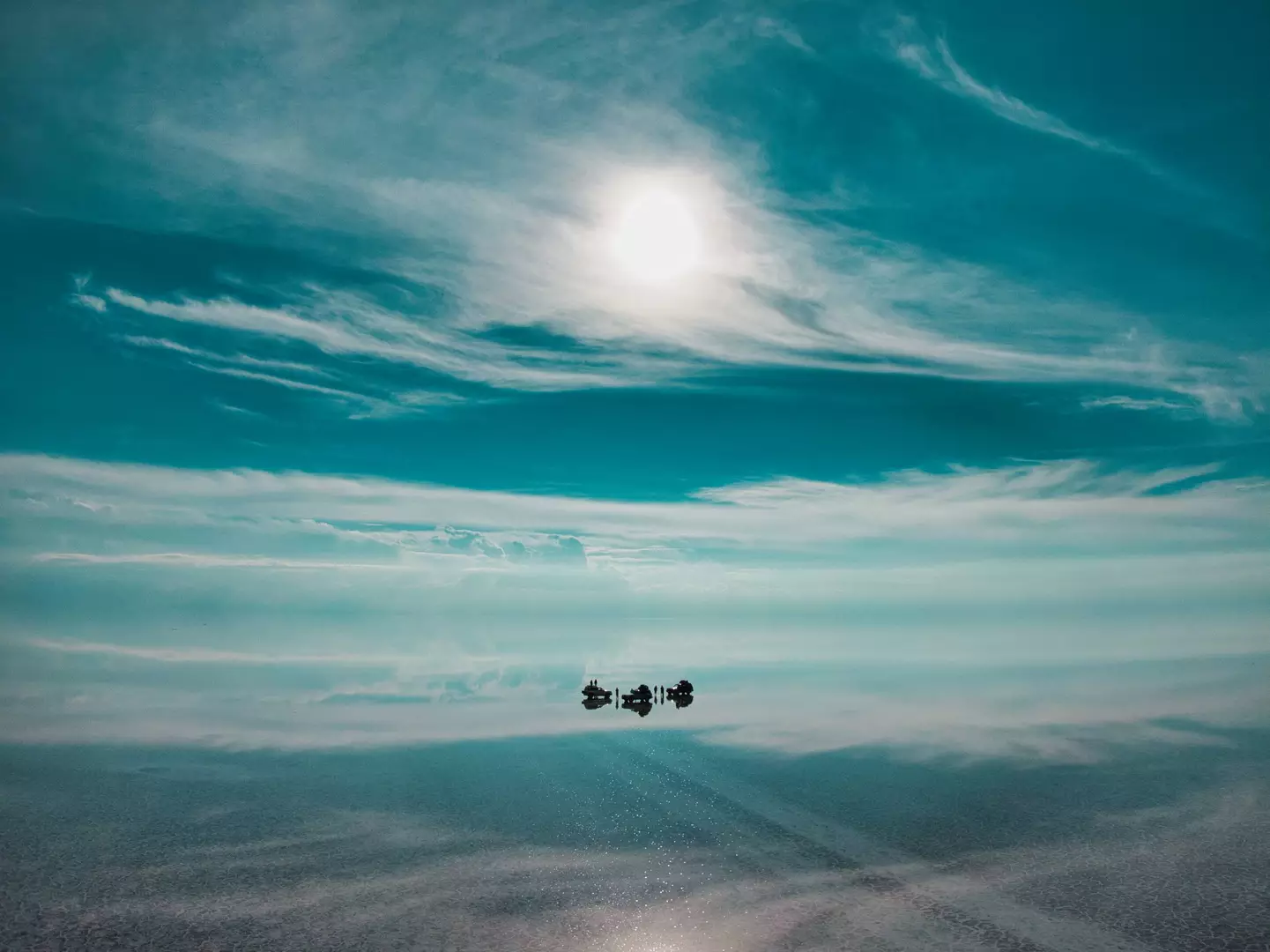
Dry season (roughly May to November): the white desert
When the salt dries, the surface hardens into a pattern of hexagons that stretches to the horizon. This is the best time for perspective photos, for reaching Isla Incahuasi, and for combining the Salar with the colored lagoons and geysers further south. Skies are usually clear, but nights are very cold.
Our tip
April and November are transition months. In April you can sometimes still find patches of water for mirror photos while most routes are open. If the mirror effect is your top priority, aim for January to March and keep your dates flexible.
How to get to Uyuni
From La Paz by bus
The most common option is an overnight bus from La Paz. The trip takes around 8 to 10 hours and arrives early in the morning, so you can start a tour the same day. Choose a tourist-class bus with reclining seats and heating — the altiplano gets very cold at night.
From La Paz by plane
Flights from La Paz to Uyuni take about an hour. They cost more than the bus, but they save you a full night of travel. Our Bolivian White Treasure Express includes round-trip flights, so you can see the Salar in a single day and sleep in La Paz.
Not sure which to choose? Read our detailed comparison: La Paz to Uyuni: bus vs flight.
From San Pedro de Atacama, Chile
Many travelers cross between Chile and Bolivia on a multi-day route through the high desert, with the Salar as the grand finale (or the starting point). It is one of the most spectacular overland journeys in South America.
What to see on a Uyuni tour
Train Cemetery
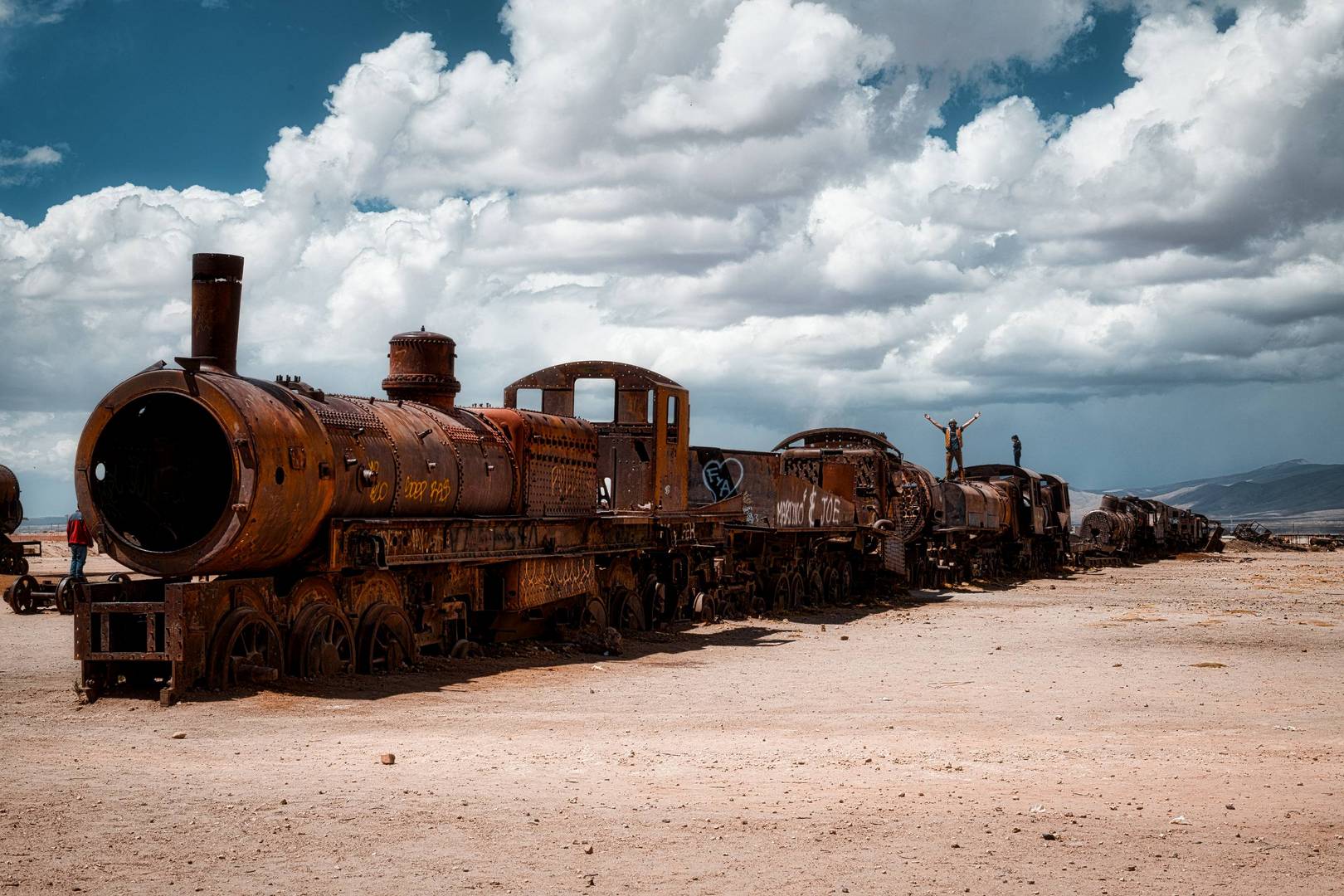
Just outside Uyuni town, rows of rusted steam locomotives from Bolivia's mining boom sit in the open desert. It is usually the first stop of the day and a favorite for photos.
Colchani
A small village on the edge of the Salar where local families extract and process salt by hand. It is a good place to learn how communities live from the salt flat and to buy local crafts.
Isla Incahuasi
An island of rock and giant cacti rising from the middle of the salt. Some of the cacti are many centuries old — they grow only about a centimeter per year. A short hike to the top gives you a 360° view of the white horizon.
Sunset, stargazing and sunrise
With almost no light pollution and very dry air, the Salar has one of the clearest night skies on Earth. On a moonless night you can see the Milky Way with the naked eye. We run dedicated sunset, stargazing and sunrise tours, and a combo that covers all three in one night: A Salty Night Out.
The colored lagoons and geysers
South of the Salar, the Eduardo Avaroa National Reserve is home to Laguna Colorada (a red lagoon full of flamingos), Laguna Verde beneath Licancabur Volcano, the Sol de Mañana geysers at nearly 5,000 meters, the surreal Dalí Desert and the famous Stone Tree. You need at least two or three days to include this region.
How many days do you need?
- 1 day: the classic Salar highlights — Train Cemetery, Colchani, the salt flat and Isla Incahuasi. See our One Day Uyuni Salt Flats Tour.
- 2 days: the Salar plus either the lagoons or the volcano area. Try the Salt Flats & Lagoons Tour or the Full Salt Flats Tour.
- 3 to 4 days: the complete southwest — Salar, lagoons, geysers and desert — ending in Uyuni, Chile or the red canyons of Tupiza. See Uyuni to Tupiza — 4 Days.
- A full Bolivia trip: combine Uyuni with La Paz, Lake Titicaca, Sucre and Potosí on itineraries like Bolivia Explorer — 8 Days.
Practical tips from our guides
Altitude
Uyuni is at about 3,650 meters, and the lagoon route goes close to 5,000. Spend a couple of days in La Paz or another high city first, drink plenty of water, eat light and avoid alcohol on the first days. Coca tea helps many travelers. If you have a medical condition, check with your doctor before the trip.
Cold and sun
Days can be warm, but nights and early mornings drop well below freezing, especially from May to August. Dress in layers, bring a warm jacket, gloves and a hat. The sun at this altitude is intense: use high-factor sunscreen, sunglasses and lip balm.
What to pack
- Warm layers and a down jacket
- Sunglasses, sunscreen and a hat
- Rubber boots or sandals for the rainy season (the salt water damages shoes)
- Cash in bolivianos for park fees, toilets and snacks
- A power bank — charging points are limited outside Uyuni
- Small props for perspective photos
Park fees
Some entrances are paid locally in cash, for example Isla Incahuasi (30 Bs) and the Eduardo Avaroa National Reserve (150 Bs). Each tour page tells you exactly what is and isn't included.
Choose your operator carefully
Prices in Uyuni vary a lot, and so do safety standards. Before you book, ask about the condition of the vehicles, the driver's experience, whether the guide speaks English, group size and what happens if the weather changes the route. A good operator answers all of this clearly.
Photography tips
- Golden hours: sunrise and sunset give the softest light and the best reflections.
- Perspective photos: keep the camera low, close to the ground, and place your props near the lens while people stand far away.
- Bright colors: red, yellow and orange clothing stand out against the white salt.
- Night shots: bring a tripod and use long exposures for the Milky Way.
- Protect your gear: salt water and fine salt dust damage cameras — keep a cloth and a bag handy.
Sources and further reading: Wikipedia: Salar de Uyuni.
Plan your Uyuni trip with Andes 2 Amazon
Andes 2 Amazon is a Bolivian tour operator based in La Paz. Since 2012 we have guided travelers across Bolivia, Peru and Argentina with private 4WD vehicles, small groups and English-speaking guides. We can build your Uyuni trip around your dates, your fitness and what you most want to see — mirror, stars, lagoons or all of them.
Explore all our tours or contact us and tell us your dates. We will design the right itinerary for you.

